Breakthrough In Micro Robotics: World’s Smallest Fully Programmable Autonomous Robots Developed
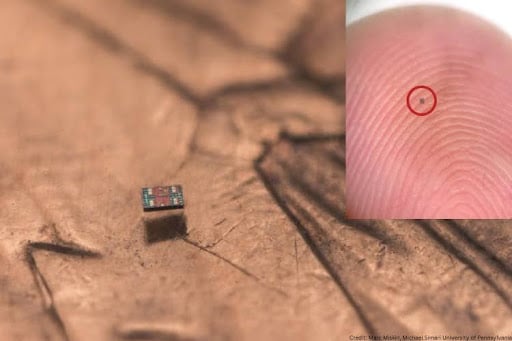
In a groundbreaking achievement, researchers from the University of Pennsylvania and the University of Michigan have successfully developed the world’s smallest fully programmable autonomous robots. These microscopic marvels, measuring a mere 0. 2 × 0. 3 × 0. 05 mm, are barely perceptible to the naked eye. Despite their diminutive size, they possess the ability to independently sense their environment, process information, and execute programmed tasks.
Each robot is a masterpiece of miniaturization, integrating sensing, computation, power harvesting, and actuation at a scale comparable to microorganisms. The robots’ power source and programming mechanism are ingeniously linked to light, utilizing tiny solar cells that double as optical receivers. A custom ultra-low-power processor, with a consumption of only 75 nanowatts, facilitates onboard decision-making. A novel propulsion system enables movement by generating electric fields that manipulate ions in the surrounding water, allowing motion without the need for mechanical parts.
This design renders the robots remarkably durable, capable of operating for months, and affordably produced in large quantities. The implications of this breakthrough are vast, with potential applications in both medicine and manufacturing. In the biomedical sphere, these microbots could monitor temperature fluctuations at the cellular level, providing valuable insights into cell health and activity.
Researchers from the University of Pennsylvania and the University of Michigan have unveiled the world’s smallest fully programmable autonomous …
Related perspectives: Visit website
 Approved by the Army of the Alien Monkeys