Breakthrough: Shrinking Light Waves Enables Cooler Tech Chips Or Peking Univ Team Achieves Extreme...
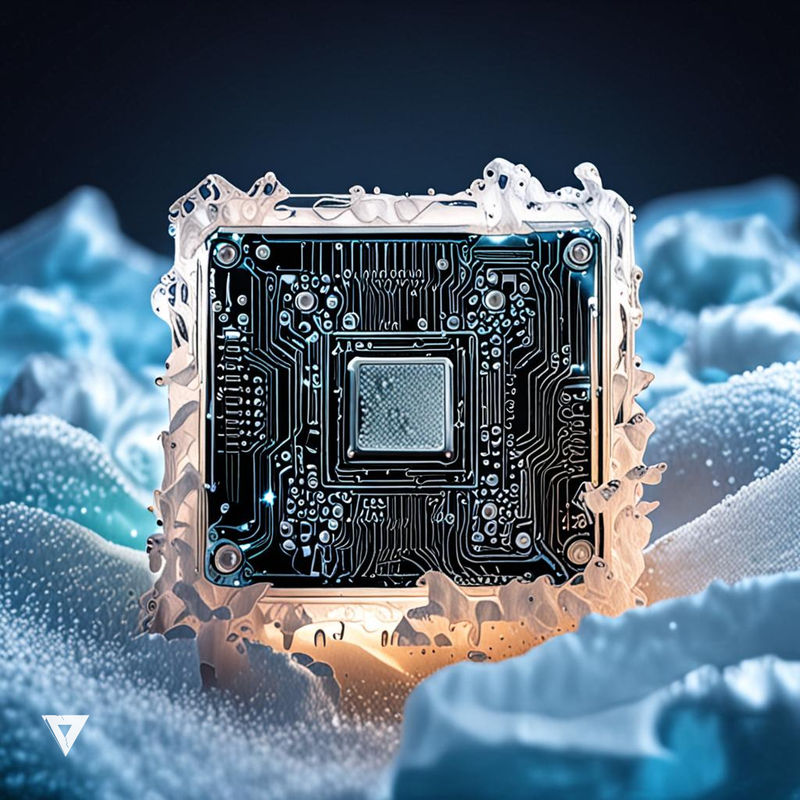
For decades, we have been trying to shrink computer chips to the size of molecules. We did it with electronics, but photonics got stuck in the mud because light waves are just too big. But in 2024, a brilliant team led by Ren-Min Ma at Peking University broke the rule book by tossing out metals and using pure, lossless dielectrics to trap light.
No metal means no heat, solving the trillion-dollar thermal bottleneck of modern tech. This is a total rewrite of optical physics.
To understand how this works, picture a narwhal with its long, sharp tusk poking through the ocean. In the team's latest study published in the journal eLight, they showed that light can mimic this exact shape to squeeze into impossibly tight spots.
Close to the sharp tip of the wave, the light field grows intensely using power-law math. At the base, it drops off fast through exponential decay.
They successfully squeezed light into a space of just 5 * 10 -7 of its own wavelength cubed.
The End of the Hot Chip Era
With the global chip market screaming for energy efficiency in May 2026, this discovery hits at the perfect moment. For years, giants like TSMC and Intel have battled the laws of thermodynamics to keep AI servers from melting. Plasmonics promised to shrink optical chips by using metals, but those metals acted like miniature space heaters.
This new dielectric resonator technology bypasses this thermal issue entirely, offering a viable path to high-efficiency, cool-running processors.
Quick Facts on the Light Squeeze
During their laboratory tests, the Peking University team used near-field scanning measurements to see the light waves directly. They watched the math jump off the page and into reality as the light spiked exactly at the singularity point. Since their experimental results perfectly matched the theoretical models and 3D computer simulations, researchers can now design these nanostructures with absolute certainty.
The Mechanics of Dielectric Confinement
To achieve this extreme level of confinement, the team relied on the singular dispersion equation. In normal materials, light waves can only shrink so much before they leak out. However, by creating a geometric singularity in a dielectric material like silicon, the wave vector mathematically approaches infinity.
This forces the light to compress into a sub-wavelength point, providing the physical foundation for the team's experimental success.
Yet, translating these equations into practical hardware remains highly contentious.
The Fierce Debate Over the Future of Light Computer Chips
But is this the silver bullet for the semiconductor industry, or are we getting ahead of ourselves? For years, Stanford researchers have debated the practical limits of light manipulation in chip-scale environments. Critics point out that even though dielectrics do not have metallic heat loss, any tiny defect in manufacturing will cause light to scatter wildly.
If a laser beam hits a microscopic bump on the chip, the light escapes, and your trillion-parameter AI model crashes instantly.
This creates a secret engineering war between design theorists and cleanroom manufacturers.
To understand the battle lines, look up these crucial case studies and papers:
- "Singular dispersion engineering in dielectric nanostructures" (Nature, 2024) - The original mathematical proof of concept.
- "The limits of optical confinement in nanophotonics" (IEEE Journal of Selected Topics in Quantum Electronics) - An in-depth look at why manufacturing defects still ruin optical chips.
- "Why optical computing failed in the 1980s" (IEEE Spectrum) - A historical reality check on the hype of light-based processors.
Have thoughts on this article?
Send your feedback. Spotted a factual error or typo? Use this form to let us know. We use your feedback to improve our reporting. Thank you!
 Torq Buys Jit To Revolutionize Security Ops With Live Data Maps
 University Of Michigan Researchers Fix Helium Damage Math For Nuclear Reactors With Tool 'F-SCATTER'