Mysterious ‘Lemon-Shaped’ Exoplanet Defies Explanation With Unusual Composition And Distorted Form
Astronomers using the James Webb Space Telescope have stumbled upon an enigmatic exoplanet, PSR J2322-2650b, that continues to defy explanation. This Jupiter-mass gas giant, with an atmosphere enriched in carbon, yet strikingly devoid of nitrogen and oxygen, presents a paradox. According to Michael Zhang, a postdoctoral researcher at the University of Chicago, “everywhere in the universe, where there’s carbon, there tends to be nitrogen and oxygen.” The unusual composition of PSR J2322-2650b’s atmosphere was revealed through its emission spectrum, which showed wavelengths corresponding to molecular carbon.
This discovery has led scientists to speculate that carbon may also be present at the planet’s core in the form of diamonds. What makes this exoplanet even more extraordinary is its peculiar shape, resembling a lemon, which is a result of the gravitational pull from its host star, a small, dense pulsar. The pulsar, characterized by its regular pulses of electromagnetic radiation, exerts a significant influence on the planet, causing it to become distorted.
While other gas giant exoplanets orbiting ordinary stars have been found to be distorted, PSR J2322-2650b’s lemon shape is particularly pronounced.
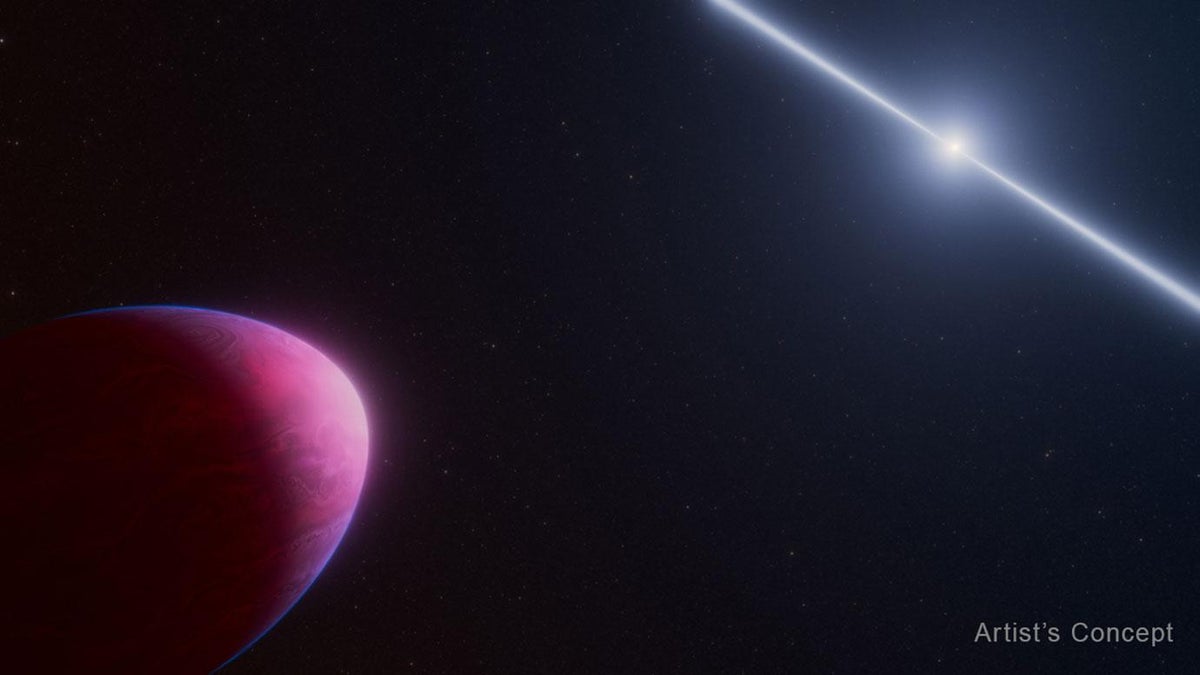
Astronomers using the James Webb Space Telescope have discovered a bizarre-looking exoplanet that defies explanation
Related perspectives: See here
 Approved by the Army of the Alien Monkeys