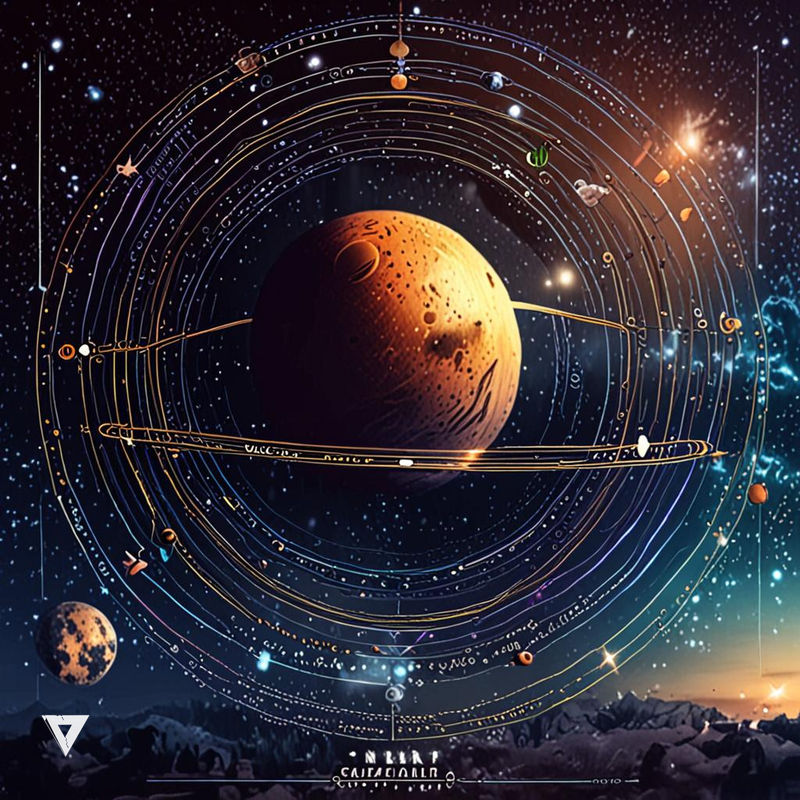
Right now, as you sip your midnight coffee, the solar system is gathering for a rare meeting. Mercury, Saturn, Mars, and Neptune are moving into a tight cluster in the early morning sky of April 18, 2026. This grouping is a planetary alignment, occurring because gravity has pulled these massive worlds into a narrow window of our sky that will disappear as soon as the sun rises.
While the event is global, the Southern Hemisphere offers the best seat in the house. The planets rise much higher above the horizon there, staying visible for a longer duration. Over in the United States, your luck depends on your latitude. If you live in Houston or Miami, you have a front-row ticket, but for those in the north, the planets will hug the horizon and disappear quickly.
Visualizing the full scope of the event requires more than just a clear horizon. While Mercury, Mars, and Saturn are visible to the naked eye, Neptune is far too dim to catch without assistance. To see the blue planet, you must use a high-powered telescope or very strong binoculars, as the universe often hides its most distant treasures from the unaided eye.
The clock is ticking on this window of opportunity. While the peak is right now, the planets stay in this general area until April 22, after which they drift back into the depths of their own orbits. Mercury, moving the fastest due to its proximity to the sun, will be the first to leave the cluster. This path across the sky is not random, but part of a larger celestial geometry.
Beyond the headlines
Behind the pretty lights lies a mathematical truth called the ecliptic. All planets in our system orbit the sun on a relatively flat plane, which is why they always seem to follow the same path across our sky. When we see an alignment, we are simply seeing these worlds pass each other on their celestial tracks. In April 2026, Saturn is actually nearing its “ring plane crossing,” where its famous rings appear as a thin, sharp line. This makes Saturn look more like a glowing needle than a hula-hoop, offering a rare look at the giant planet’s profile.
The Cost of a Clear View
Witnessing this profile requires trading your sleep for a cold morning outside. If you stay in your warm bed, you miss a sight that will not repeat in this exact way for years. Similarly, city dwellers must decide between the convenience of home or driving to a dark field to escape light pollution, which can easily mask the more subtle details of the alignment. Before you head out into the cold, test your knowledge of the forces that keep these planets in place.
The Secret Math of the Sky Quiz
Which of these planets is actually “falling” toward the sun right now?
- A) Mercury
- B) Mars
- C) All of them
- D) None of them
The Twist: The answer is C. Every planet is constantly falling toward the sun due to gravity, but they move sideways so fast that they constantly miss it. This is what an orbit actually is—a permanent state of falling.
Additional Reads:
1. How Orbits Work
2. The Laws of Celestial Mechanics
3. The Truth About Alignments
The Great Cosmic Lie: Are They Really Aligned?
Understanding gravity helps explain the motion, but it doesn’t account for the optical illusion of the alignment itself. Is it even fair to call this an alignment? In reality, these planets are millions of miles apart in deep space; they only appear clustered because of our specific vantage point on Earth.
Some astronomers argue that using the word “alignment” is misleading, yet the visual beauty of this perspective remains undeniable.
For more on how these perspectives work, look at the Planetary Society’s guide.
The Clockwork Behind the Morning Sky
Whether you call it an alignment or an illusion, the timing is dictated by the precise clockwork of the solar system. Inside the mechanics of this 2026 event, the positions are dictated by orbital resonance. Mars takes about 687 days to circle the sun, while Saturn takes 29 years.
Getting them to appear in the same small patch of sky requires precise timing.
During the early hours of April 18, the Earth is positioned so that we are looking “sideways” out of the solar system.
This creates the compact visual cluster.
Astronomers at the Royal Observatory note that these groupings are the best times to measure the relative speeds of the planets, allowing you to see how much faster Mercury moves compared to the distant, sluggish Saturn over just two mornings.
Have thoughts on this article?
Send your feedback. Spotted a factual error or typo? Use this form to let us know. We use your feedback to improve our reporting. Thank you!
 Sizzling Sands, Savage Roars, And Nuclear Storms: Monarch Legacy of Monsters [What If]
