Unveiling The Secrets Of Exoplanetary Systems: Breathtaking Images Of Debris Disks Captured By …
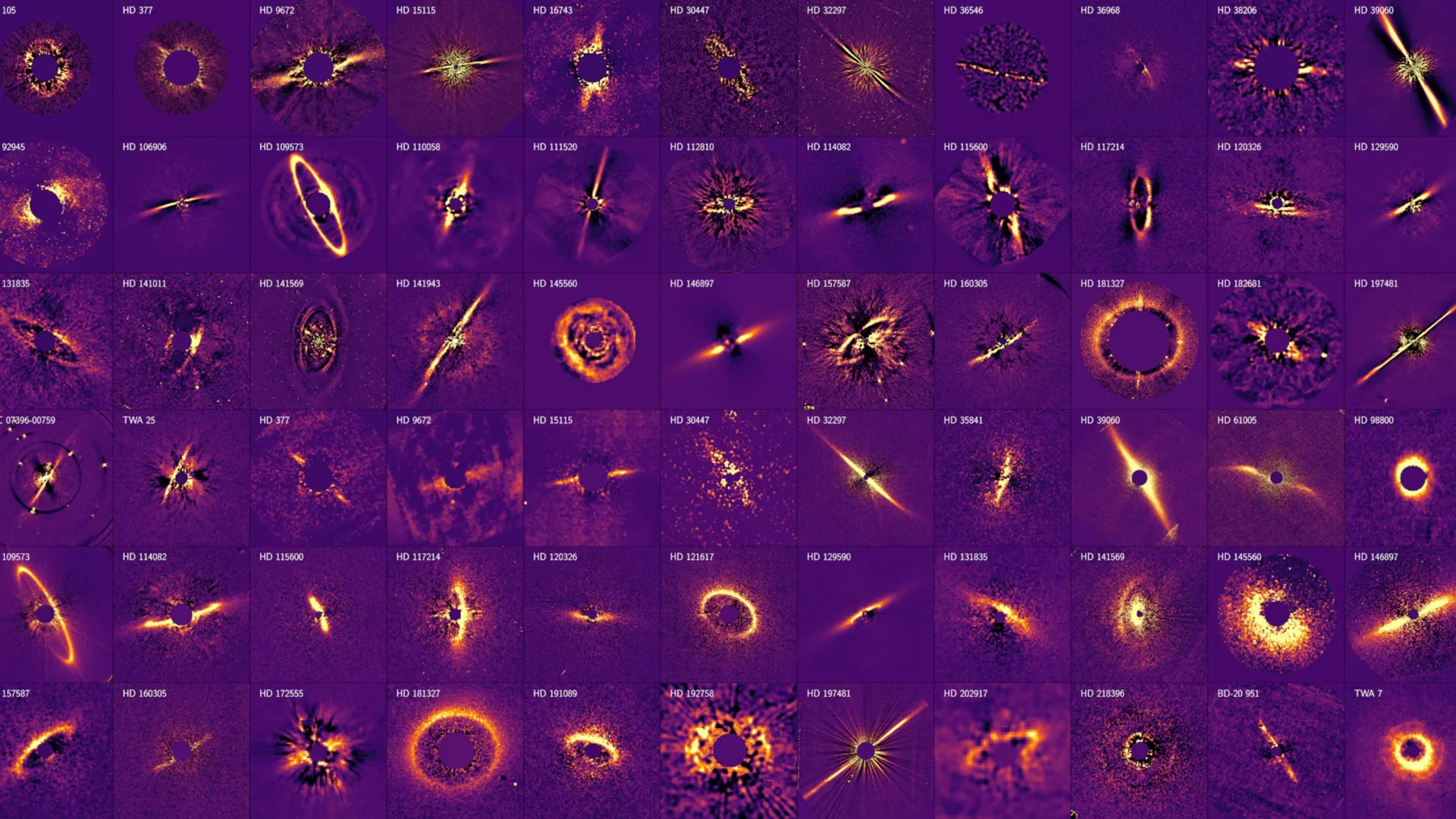
Astronomers have unveiled a breathtaking collection of images captured by the SPHERE instrument on ESO’s Very Large Telescope, showcasing debris disks in a diverse range of exoplanetary systems. These dusty structures offer a rare glimpse into the early stages of planetary development, revealing where small bodies orbit their stars.
The images, described as an “astronomical treasure” by Gaël Chauvin, project scientist for SPHERE and co-author of the study, provide exceptional insights into the properties of debris disks. By analyzing these disks, scientists can infer the presence of smaller bodies like asteroids and comets, which are impossible to observe directly.
In our own solar system, beyond the planets and dwarf planets like Pluto, lies a vast array of smaller, or “minor,” bodies. These objects, ranging from about a kilometer to several hundred kilometers in size, hold significant importance. Those that occasionally release gas and dust, forming visible features like tails, are classified as comets, while those that do not exhibit such activity are labeled asteroids.
These small bodies preserve clues to the solar system’s earliest days, serving as remnants of the transitional phase in which tiny grains grew into planets. Asteroids and comets are essentially planetesimals that never developed into full-size planets, offering altered traces of ← →
Using the SPHERE instrument on ESO’s Very Large Telescope, astronomers have created an extraordinary set of images showing debris disks in a wide …
Looking to read more like this: See here
 Approved by the Army of the Alien Monkeys