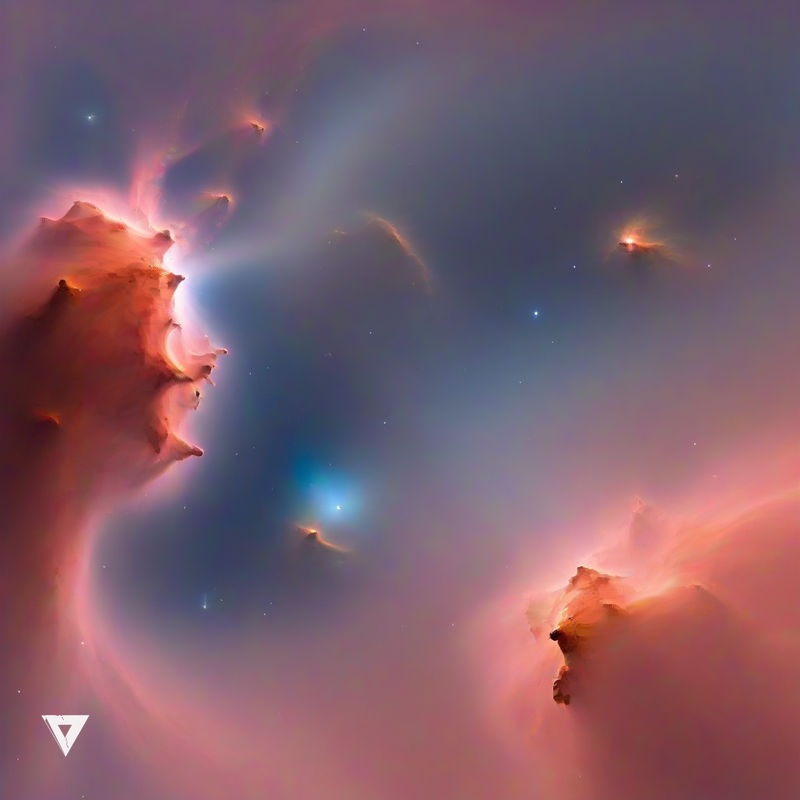
NASA released a striking image of the Trifid Nebula on April 20, 2026. This event honors the thirty-sixth year of the Hubble Space Telescope since its launch in April 1990. This new view shows a small part of a massive cloud located 5,000 light-years away. In this light, the gas looks like silk moving in deep ocean water, and Hubble captures the fine grains of dust as they flutter through space.
Between the lines
While the gas appears delicate, the structure of the nebula is defined by immense pressure.
Around the edges of this image, giant stars are working hard. These stars are not visible in the frame, but their power is clear.
For 300,000 years, their heavy winds have carved the shapes we see today, acting like cosmic snowplows.
By pushing against the cold gas, they create a massive bubble that forces the material to clump together and wake up new stars.
Let’s get granular
Inside this glowing region, the physics of heat and light take over. The bright colors tell a story of chemical energy, and Hubble uses visible light to show us the fine details of these sediments.
Massive stars release radiation that eats away at the cooler clouds through a process called photoevaporation.
It is a slow, steady change that reshapes the entire neighborhood, using dust as the main ingredient for everything we know.
The stellar engine of tomorrow
This reshaped environment is only temporary, as the gas will eventually run out. Within a few million years, these young stars will blow the rest of their nursery away. I find it wild that we are seeing a temporary home that will one day vanish.
Scientists at the Space Telescope Science Institute use these pictures to track how fast these stars grow. These observations help us learn if our own sun had such a noisy, crowded start, and this data could even help us find where the next solar systems will form.
Fresh discoveries from the Sagittarius arm
Looking further out, the Trifid Nebula sits in the Sagittarius spiral arm of our galaxy.
Most people see three lobes and think it is a simple shape, but they are wrong.
New data reveals that the dark lanes are actually very cold, dense walls of soot that block almost all light.
In the middle of it all lies HD 164492, which many think is one star. In fact, it is a complex group of stars huddled together for warmth—a party in the middle of a vacuum.
Joseph DePasquale processed this image to show us the hidden layers of this star factory, reminding us that space is never empty.
Have thoughts on this article?
Send your feedback. Spotted a factual error or typo? Use this form to let us know. We use your feedback to improve our reporting. Thank you!
 Prioritizing Code Safety With UK Gov & Experts
