Galactic Migration Patterns Revealed: New Data Suggests Sun’s Journey To Current Position
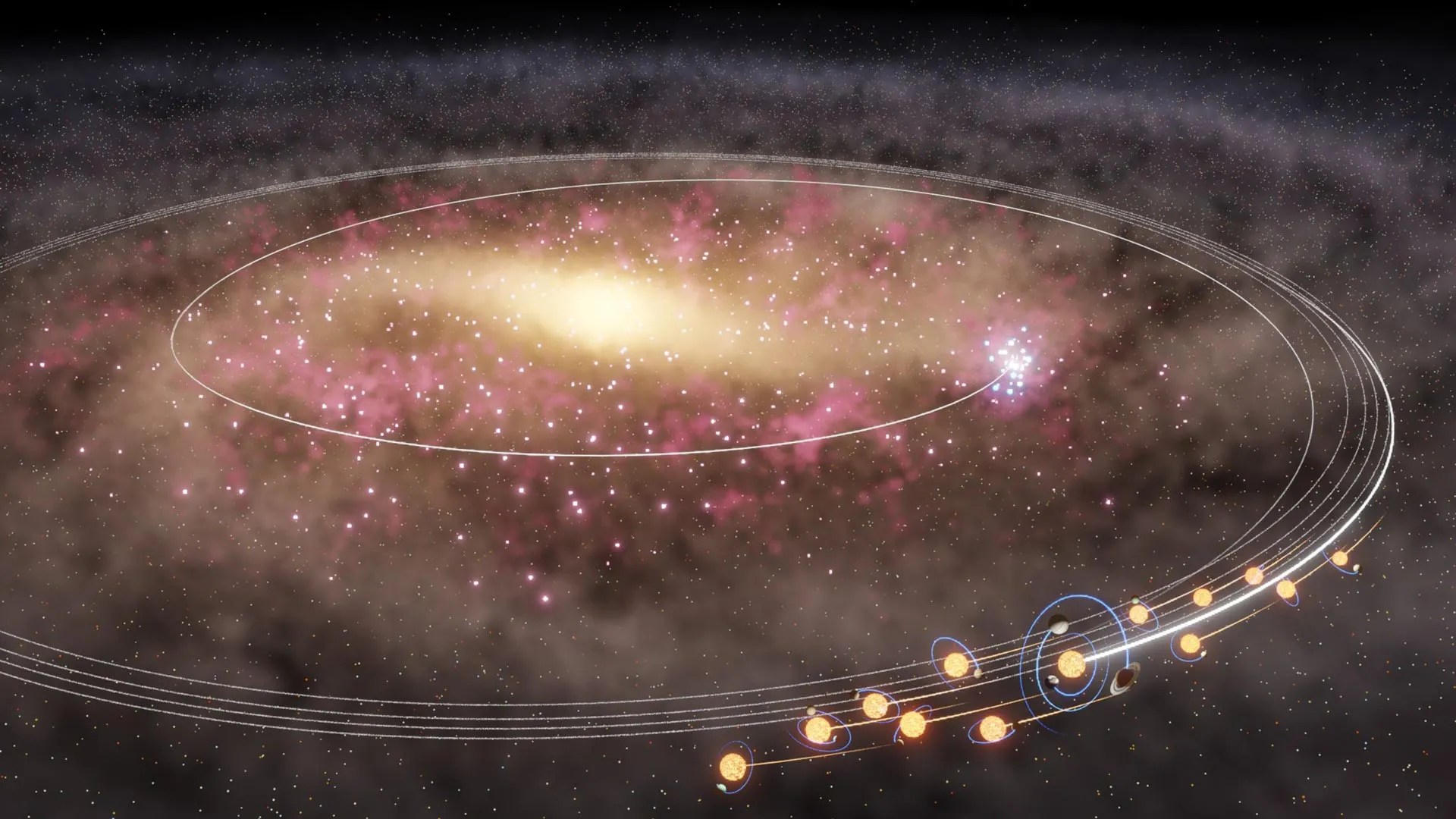
The Milky Way looks like a giant, swirling cosmic neighborhood. Data from the Gaia satellite indicates our Sun was born much closer to the galactic center than where it sits today. Most folks assume stars stay put. But the numbers tell a different story.
This discovery is an absolute win for astronomers studying the history of our home. Migration is not just for birds; it is for the very stars that light our sky.
Astronomers now realize that a massive bar of stars near the galactic center acted like a gravitational paddle four billion years ago. This rotating structure pushed thousands of stars toward the outer edges of the disk.
I dabbled in everything from orbital dynamics to stellar chemistry after reading a Nature Astronomy report. Heavy elements like iron and magnesium provide the proof. Our Sun contains more metal than its neighbors. It is a traveler from the dense inner core.
Look at the data because numbers reveal a grand relocation project across the galaxy.
About twenty percent of stars in our local area are actually immigrants from the high-density inner disk. These stars share identical chemical markers with our own Sun. And they likely formed in the same gas clouds billions of years ago. Finding these siblings confirms we are not drifting alone. Gravity from that central bar kicked us out and we landed in a spot favorable for life.
Recent scans of the sky provide a clear pattern of movement that matches computer models of the Milky Way galaxy perfectly.
Scientists used the Gaia database to track motion and chemistry simultaneously. This approach allows researchers to identify solar siblings scattered across the disk. Our Sun traveled over ten thousand light-years to reach its current position. This movement provided a stable environment for planets to form. (Tip: Scans the sky nightly for clues.) A stellar exodus! Let them watch as we piece together the journey of our home star. We used to think of the galaxy as a quiet place for stars to age. Now we know it is more like a crowded train station where everyone is changing tracks. This data changes the way we model the future of our local group.
Every data point suggests a dynamic history.
Stars with matching metal signatures are waiting to be found. These twins originated in the same dense gas clouds near the galactic center. Finding them is a major goal for future exoplanet searches. Systems like our own might be hiding among these displaced stars.
The probability is high that our siblings are out there in the dark.
The Chemical Fingerprints of Galactic Travelers
- Habitability in the outer galactic disk may be higher than previously estimated due to the influx of metal-rich stars from the center.
- Chemical evolution models for the Milky Way will require significant updates to account for large-scale radial migration of star clusters.
- Future space missions will likely prioritize these specific twin stars for exoplanet searches to find systems similar to our own.
A Cosmic Flight Log to the Suburbs
Current timelines show the Gaia Data Release 4 providing the most detailed velocity maps to date.
This massive effort focuses on the Galactic Center where the bar-shaped structure first formed. Interest centers on the Scutum-Centaurus Arm as a likely path for migrating clusters. Additional reads include studies on radial migration in the Monthly Notices of the Royal Astronomical Society. These papers explain how spiral arms can also pull stars away from their birthplaces.
We are looking at a system where nothing stays still for long. Orbiting the center is only half the story; moving outward is the other.