In 1916, the British Army rolled the first tanks across the mud of the Somme and ended the era of the cavalry charge forever. Those massive iron boxes broke the stalemate of the trenches by doing what a horse and rider simply could not. Today, a similar shift occurs in the snowy fields of Eastern Europe.
Software replaces the pilot, and the speed of the machine replaces the slow reaction of the human brain.
This evolution is personified on the modern frontline by those working to turn code into a kinetic force.
The Pulse of the Autonomous Front
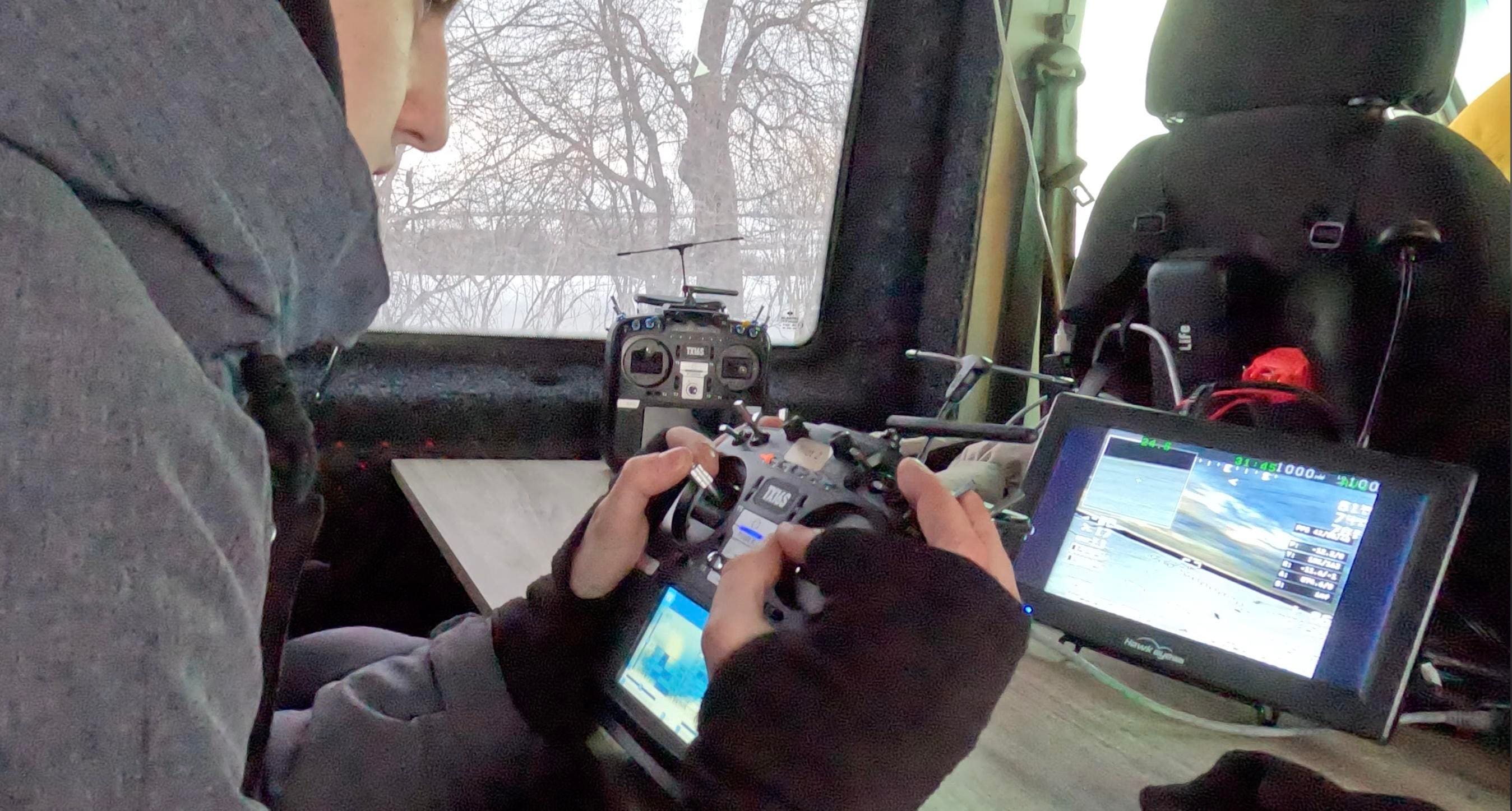
At the edge of a frozen field, Oleksandr Liannyi works inside a cramped van to refine the most dangerous code on the planet.
His company, NORDA Dynamics, produces systems that allow drones to find and hit targets without a human touch.
These machines already guide themselves to a final impact once a pilot points the way. But the goal now is a drone that hunts.
It scans the landscape, identifies a threat, and prepares to strike.
This shift happens because radio jamming makes manual control nearly impossible on the modern battlefield.
Survival depends on the drone thinking for itself.
As these systems evolve from individual prototypes to standardized tools, the military strategy behind them is shifting toward a broader strategic roadmap.
Roadmap to a Pilotless Future
The path forward moves from human-in-the-loop to human-on-the-loop.
Right now, a person still gives the final “go” for a lethal strike to satisfy legal standards.
Within a few years, that requirement will likely vanish.
Iran observes these developments closely, seeing a way to make their own systems more effective against sophisticated defenses.
Expect these autonomous swarms to move from the plains of Ukraine to the shipping lanes of the Middle East. The technology will shrink until every squad carries a robotic scout capable of making its own decisions.
Understanding this transition requires looking under the hood at the specific mechanics of how these machines actually perceive their environment.
Did anyone ever explain how the machine sees a target?
On-board processors use a method called “edge computing” to analyze video frames in real-time.
Instead of sending video back to a base, the drone processes every pixel locally to find specific shapes like the barrel of a gun or the treads of a tank. By using convolutional neural networks, the software compares what the camera sees against a massive library of military equipment.
It ignores the wind-blown trees and focuses on the heat of an engine or the sharp angles of a hidden vehicle.
This allows the drone to ignore electronic warfare because it does not need a GPS signal or a radio link to stay on target.
Once a machine can see and identify its objective independently, it can communicate and act within a timeframe that fundamentally alters the traditional hierarchy of warfare.
The Lethal Speed of the Software Command Chain
During the 2020 Nagorno-Karabakh conflict, we saw a glimpse of how drones destroy traditional ground forces.
But those machines still relied on human hands.
That is why the “software command chain” will take over. If a swarm of fifty drones enters a valley, a human cannot track them all. The drones must talk to each other and divide the targets.
For some, this raises a terrifying question about who is responsible for a mistake.
For the soldier in the trench, the only thing that matters is that the drone hits the enemy before the enemy hits them. This change is already here.
The realization of this automated command chain is not happening in a sanitized laboratory, but in improvised workshops under constant threat of bombardment.
Behind the Scenes of Drone Development
Engineers in Kyiv and other cities work in secret locations to avoid missile strikes.
They take graphics processing units designed for video games and repurpose them to run target-recognition algorithms.
Because supply chains are tight, they often strip parts from consumer electronics to build their flight controllers.
These teams test their code in the middle of active war zones, getting immediate feedback on what works against Russian jamming.
They do not have the luxury of long research cycles.
If the code fails, the drone is lost, and the mission fails.
The speed of this field-tested innovation has led to a surge in capabilities reported in just the last few weeks.
New Developments Since March 26 2026
In the last two weeks, fresh reports from the front lines show a massive increase in coordinated swarm attacks.
These groups of drones now use a decentralized logic where no single “leader” drone exists.
If the enemy shoots one down, the rest of the group redistributes the mission goals automatically.
Defense analysts note that this makes the swarm almost impossible to stop with traditional anti-air guns. Across the globe, military planners now scramble to rewrite their manuals because the machines have taken the lead.
 Protecting Your Assets From Digital Fraudsters: A Tactical Guide to Modern Scams