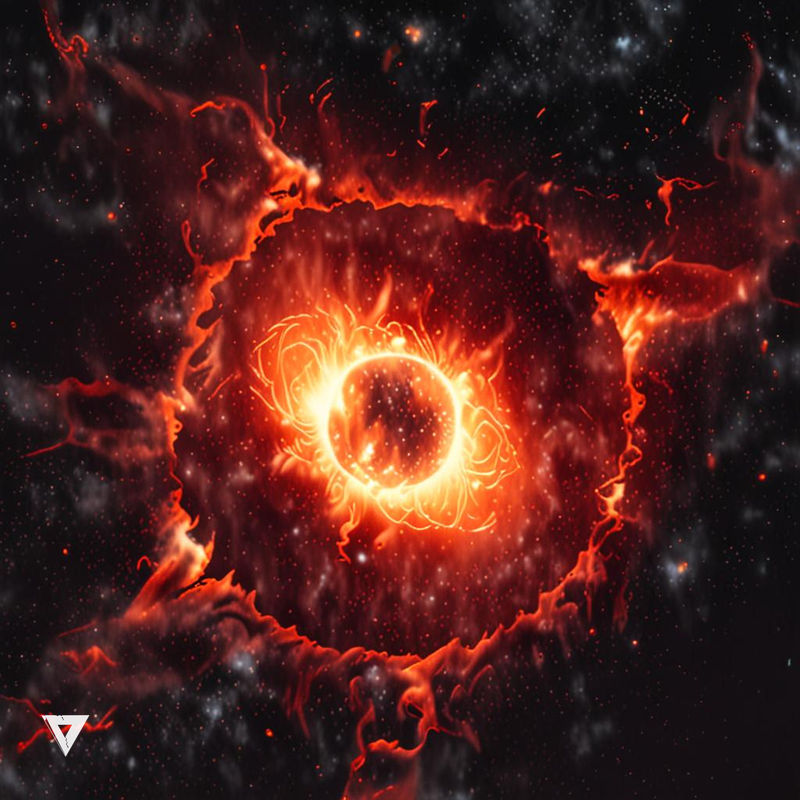
Turbulence is the great ghost of physics. We see it in a cup of tea and in the heart of a star. Yet, we cannot truly pin it down with old tools. Most of the universe is plasma, a wild, hot gas that carries electricity.
This plasma, which makes up 99% of everything we can see from the sun to the space between galaxies, does not follow simple paths.
It twists and loops in a thick sea of electric energy.
If we use standard computer math, the energy in our models just vanishes into nowhere.
That is a lie. Michael Roop fixes this lie by making the computer respect the laws of the universe from the start.
He treats the math as a physical object that cannot be broken, mapping the cosmic storm without losing sight of the wind.
Diving right into it
To move beyond these mathematical failures, researchers are focusing on how plasma moves in ways that look like a mess but follow strict rules. Understanding this behavior is the only way to understand our place in the sky, requiring a shift from traditional modeling to a more structured approach.
An all-access look inside
At Linköping University, this new math turns equations into blocks called matrices. Instead of smooth lines, it uses a grid that mimics the hidden structure of space. This is the Lie–Poisson reduction.
It is a way of saying we keep the spin and the heat in balance.
Because of this, we can now look at how magnetic fields in space last for millions of years.
Without these methods, the magnetic fields in our computer models would just fade away like smoke.
This math is the guardrail for reality.
It keeps the simulation from drifting into fantasy.
The Cosmic High-Wire Act
The practical application of these mathematical guardrails can be seen in the following upcoming events and tools:
- Check the 2026 International Space Weather Week starting May 12 in Copenhagen to see these models in action.
- Watch the live data from the Parker Solar Probe as it passes the sun again next month to compare real plasma to Roop’s math.
- Download the new Julia programming language toolkits that now include these matrix commutator tools for your own home tests.
- Join the open-source PlasmaPy group to help code these new geometric rules into the next version of their software.
The Great Battle Of The Invisible Fluid
While these tools advance our understanding, a philosophical rift remains in the scientific community. Some scientists think we only need big statistics to understand the stars. They say if you track enough random bits, the truth comes out. I think they are wrong.
You cannot solve a deep puzzle by guessing.
Roop proves that the shape of the math must match the shape of the world.
In the Journal of Plasma Physics (2025, Volume 91), experts argue if these matrix models are too heavy for small computers.
But why settle for a fast guess when you can have a slow truth?
We need to stop using tools that ignore the basic rules of nature just because they are easy to run. Using the wrong math is like trying to play a piano with a hammer.
New Tools For The Electric Sky
The core of this debate is best illustrated by comparing the accuracy of different computational methods. The Euler method is like a bucket with a hole. It lets the physical properties leak out during the calculation until the results are useless. Roop’s method is a sealed tank. It uses time-stepping that looks at the “geometry” of the problem.
This means if the physics says energy is saved, the math saves it too. This is huge for fusion power research on Earth.
If we can map plasma better, we can hold a star in a jar to power our homes.
This moves us closer to clean energy that never runs out. We are finally learning to speak the language of the stars.
It is the only way to build a future that actually works.
Have thoughts on this article?
Send your feedback. Spotted a factual error or typo? Use this form to let us know. We use your feedback to improve our reporting. Thank you!
 Artemis II Mission Achieves Milestone