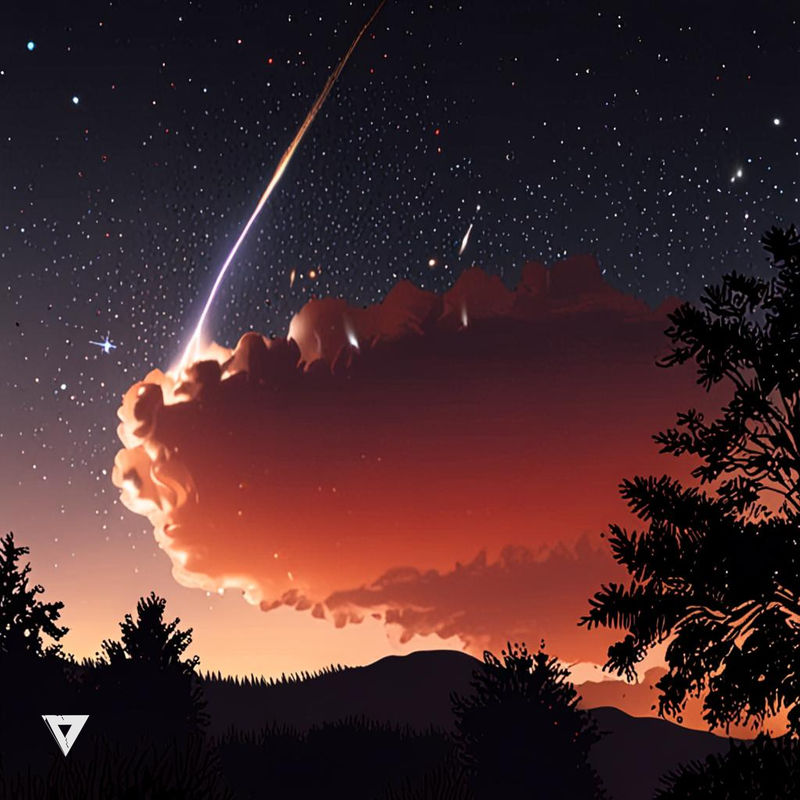
Get ready! The Lyrid meteor shower is hitting its peak in less than 48 hours. These space rocks are pieces of Comet C/1861 G1 Thatcher. This comet takes 415 years to orbit our Sun. It was last seen when Abraham Lincoln was in office.
Right now, we are hitting the dust trail it left behind centuries ago. It is a piece of history crashing into our air at 110,000 miles per hour! Under the right conditions, you see bright flashes called fireballs.
These are not just tiny specks.
These are bold, bright streaks that can light up the whole sky.
In the high mountains of Hawaii, the Subaru Telescope sits above the clouds. Its live feed on Mauna Kea is the gold standard for sky watching. At nearly 14,000 feet, the air is thin and crisp.
This means the camera sees things your eyes would miss in a big city. You get a front-row seat to the vacuum of space.
It is the best view on the planet.
And you can watch it while wearing your pajamas!
Don’t let a little bit of bad weather ruin your chance to see the universe in action.
Down in the Atacama Desert in Chile, the ALMA Observatory offers a view that is almost scary in its clarity. The air is so dry there that the stars do not even twinkle. They just shine like hard diamonds.
On this livestream, look for “trains.” These are glowing paths of ionized gas that hang in the air after a meteor disappears.
Some of these trails stay visible for several minutes.
It is wild! Most people think meteors vanish in a blink.
But the Lyrids like to leave a memory behind.
Around the world, people are camping out in digital chat rooms. They are the unofficial air traffic controllers of the night sky. In the Sebec Lake stream, people are timing every single flash. This is community science at its best. If you see a green streak, that is the meteor burning up nickel and iron. If it is red, you are seeing nitrogen and oxygen in our own air getting cooked by the heat. It is a giant chemistry set in the sky! It is fast, it is free, and it is happening right now.
Signal vs. Noise
The signal is the radiant point. All these meteors seem to come from the constellation Lyra, near the bright star Vega. If a streak comes from a different direction, it is just a random “sporadic” meteor. The noise is the moon. This year, the moon might be bright enough to hide the smaller streaks.
But don’t worry!
The Lyrids are famous for their bright fireballs.
A fireball can punch right through the moonlight.
Do not bother with a telescope.
You want the widest view possible to catch the big ones. Your phone or a wide-angle computer screen is actually better for this than a narrow lens.
Overheard
“I just saw a flash that looked like a strobe light!”
“Wait, was that an aurora or a meteor train at Sebec Lake?”
“The ALMA feed is so clear I can see the satellites moving in a line!”
“Check the 03:45 timestamp for a massive fireball over Mount Fuji!”
Chasing Space Dust From Your Couch
- Download a sky map app to find the star Vega so you know where the action starts.
- Check the Space Weather reports to see if a solar storm might add an aurora to the meteor show.
- Keep an eye on the Japanese feeds early in the morning for the best “Earth-grazing” meteors that skim the atmosphere.
- Set a calendar alert for the Eta Aquariid meteor shower which starts in just a few days.
The Secret Link Between Ancient Rocks and Modern Tech
In my view, watching a meteor shower online is the ultimate power move. You are using billion-dollar satellites and high-speed fiber optics to watch a rock that has been floating in the dark for thousands of years. It is a clash of eras! By connecting the dots, we see that these livestreams do more than just show pretty lights.
They provide real-time data for the American Meteor Society to track where these objects land. When you see a timestamp in a chat, you are helping scientists map the debris of our solar system.
This is not just a hobby.
This is planetary defense and history rolled into one big show. We are using the most modern tools to see the most ancient parts of our neighborhood!
Upcoming Space Fireworks You Must Mark Down Now
But wait, there is more! After the Lyrids fade, the Eta Aquariids take over in early May. These are leftovers from the famous Halley’s Comet. And later this year, we have the Perseids in August, which are usually the loudest and proudest of them all. On April 20, 2026, we are just at the start of a massive season for sky watchers. Every time you see a streak, remember you are looking at a piece of a comet that was here before your great-great-grandparents were born. So, pull up a chair, open a tab, and start hunting for those fireballs.
The universe is putting on a show, and it doesn’t cost a dime!
Have thoughts on this article?
Send your feedback. Spotted a factual error or typo? Use this form to let us know. We use your feedback to improve our reporting. Thank you!
 North Korean Hackers Steal $290M From Kelp DAO Via LayerZero
 The Great AI Tool Grab